Justice for Heiniu begins with a clear public record.
A document-based accountability review of public statements, contractual scope, independence and the delivered report.
This article presents the family's initial document-based review of the public record currently available. Part 1 addresses the contract, the process and the public statements. It does not attempt to resolve every disputed fact or determine legal liability. Additional records and a detailed analysis of the report's specific findings may be published separately through dated updates.
Quoted language is attributed to its source. All analysis and conclusions outside quotations are those of Yang Yu, based on the records identified below.
On May 4, 2026, Heiniu died during a response by the Town of Aurora's Animal Services team in Holland Landing, East Gwillimbury.
Three groups of documents now have to be read together:
- the public statements made by Mayor Tom Mrakas and the Town of Aurora;
- the contract between the Town of Aurora and Canine Foundations;
- the 362-page review delivered by Canine Foundations.
The central question is not whether the Canine Foundations review contains useful recommendations. It does.
The central question is whether the process first described publicly as an "investigation," and later described by Mayor Tom Mrakas as an "independent and unbiased review" covering "all aspects" of the incident, was the same process the Town actually commissioned under a contract that imposed express limits on its purpose.
A second question is why the Town issued a substantive public account of the incident on May 12 while saying the review remained incomplete, and whether the later findings required that account to be corrected, supplemented or clarified.
If there was a separate investigation, the public should be shown its mandate and outcome. If the Canine Foundations mandate was formally changed, the written record of that change should be produced. If neither occurred, the Town of Aurora and Mayor Tom Mrakas should explain why their public descriptions were broader than the controlling contractual language.
1. What the Public Was Told Before the Review Was Complete
May 7, 2026 - Mayor Tom Mrakas
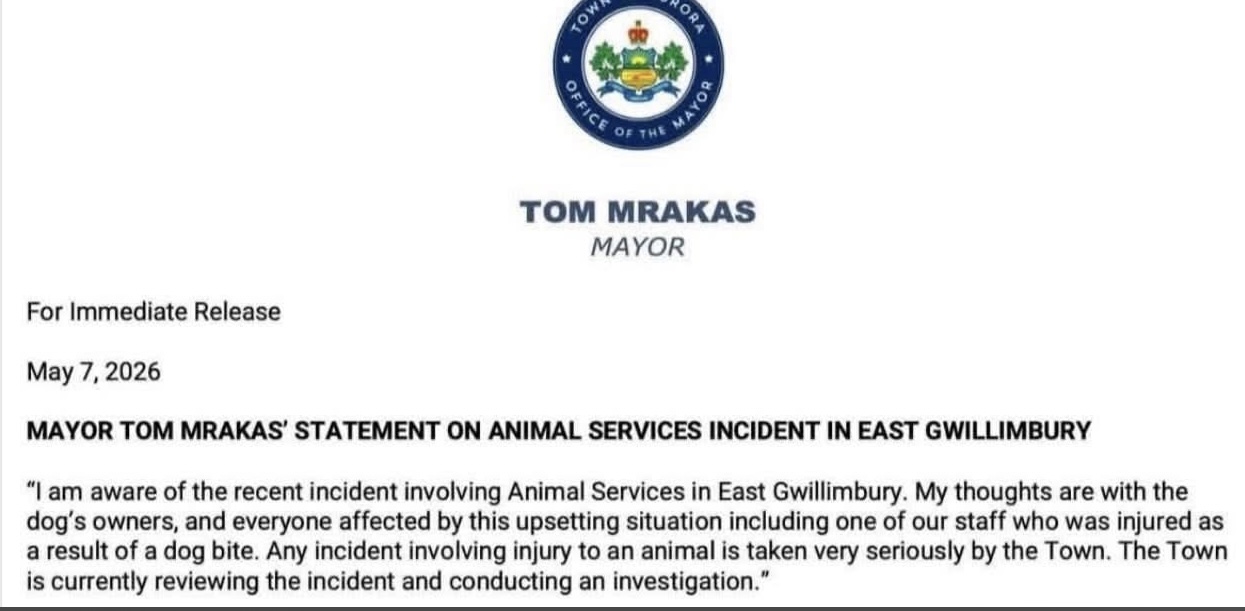
Source image: Mayor Tom Mrakas' statement dated May 7, 2026. Read the official statement on the Town of Aurora website
Aurora Mayor Tom Mrakas publicly referred to a Town employee as having been injured "as a result of a dog bite" and concluded:
"The Town is currently reviewing the incident and conducting an investigation."
The statement therefore did two things at once: it presented a factual characterization of the incident and announced that an investigation was still underway. It did not identify who was conducting that investigation, its written mandate, what evidence had already been verified, or whether it was an internal Town process, a police or regulatory process, or the work later assigned to Canine Foundations.
May 12, 2026 - The Town of Aurora
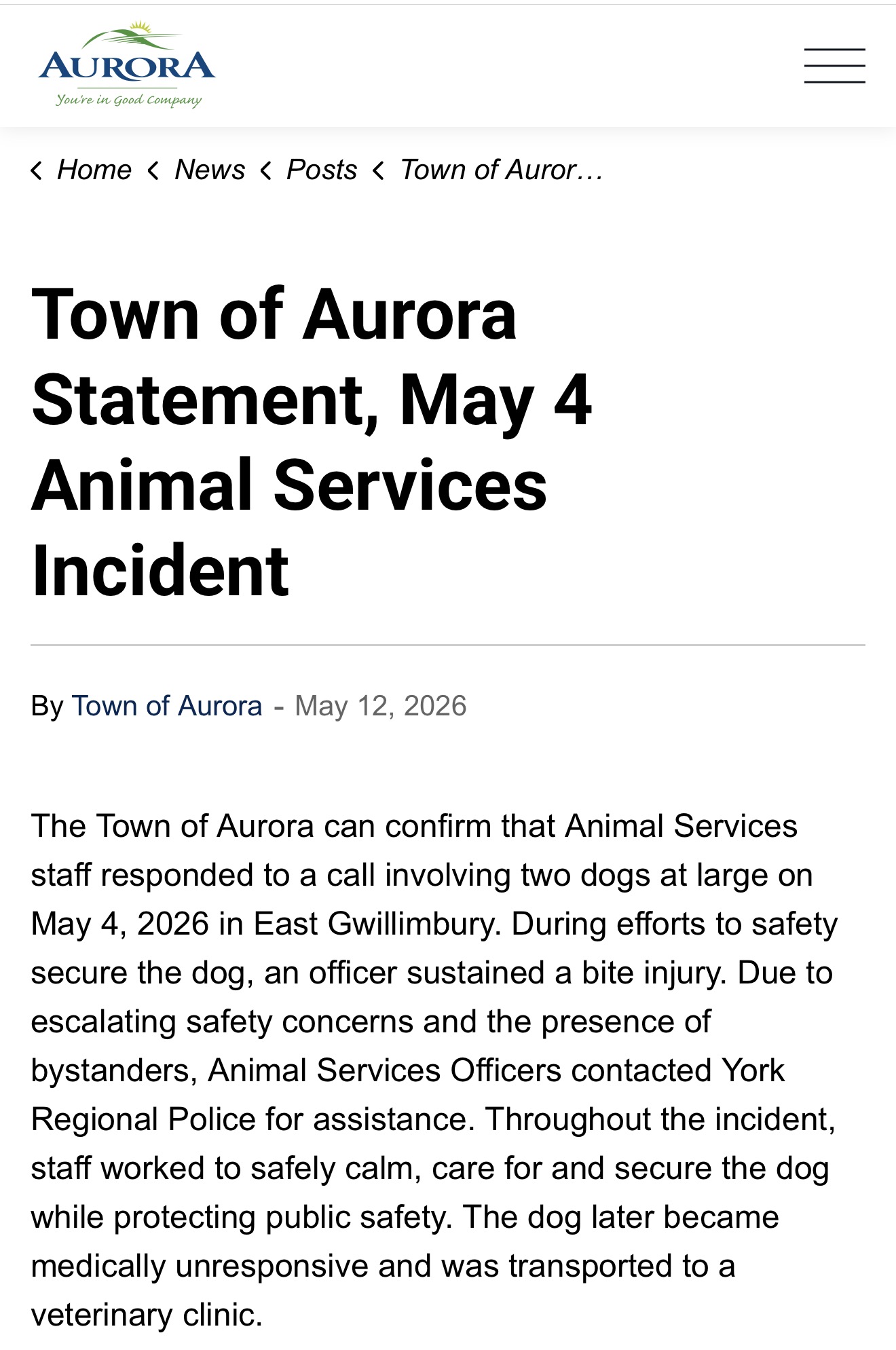
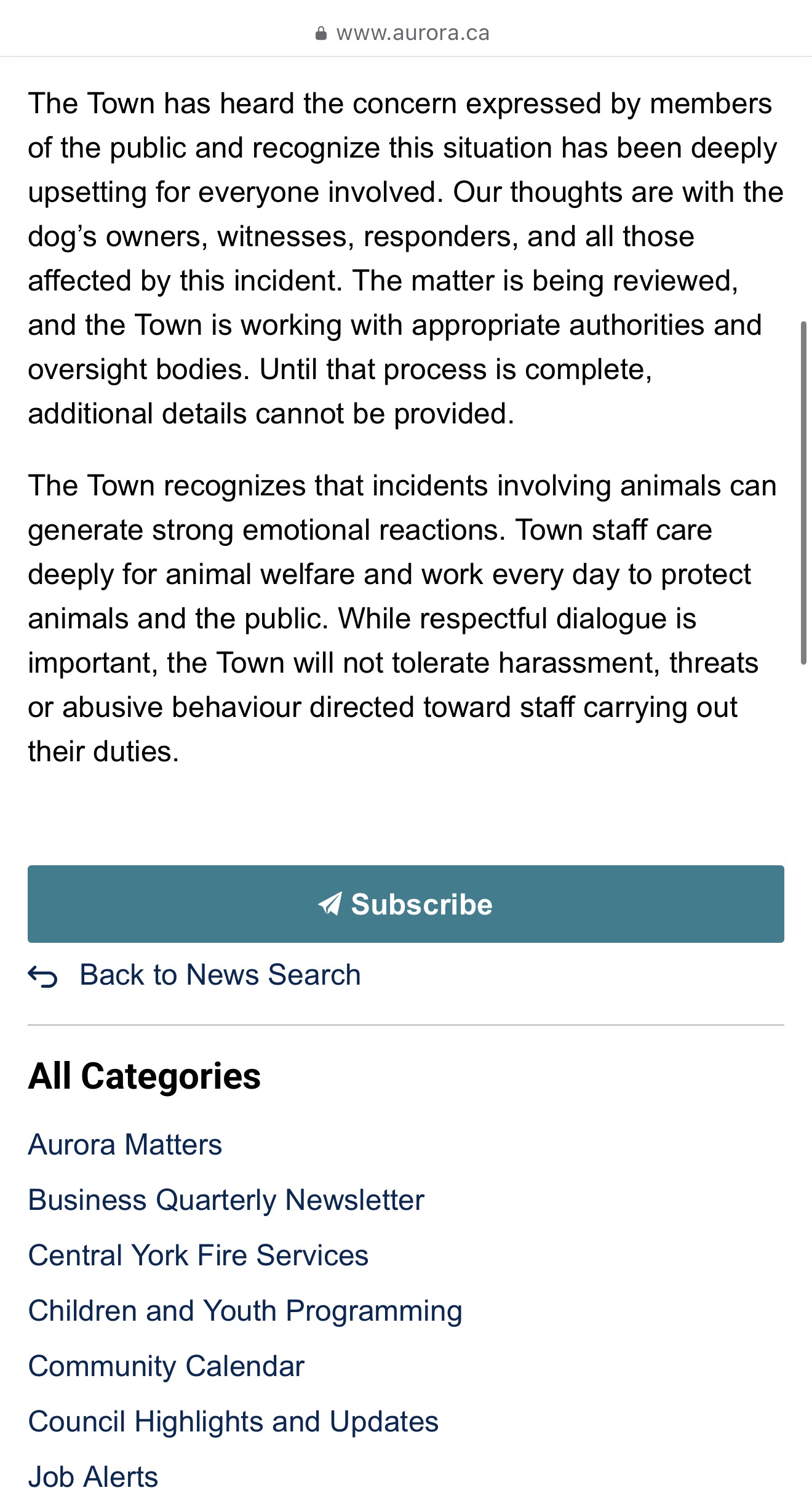
Source images: The Town of Aurora statement dated May 12, 2026. Read the full official statement
Five days later, while the review was still incomplete, the Town of Aurora published a substantially more detailed account. The Town:
- described the original call as involving "two dogs at large";
- stated that an officer sustained a bite injury during efforts to secure the dog;
- attributed the request for York Regional Police assistance to escalating safety concerns and the presence of bystanders;
- characterized staff as working throughout the incident to safely calm, care for and secure the dog while protecting public safety; and
- stated that the dog later became medically unresponsive and was transported to a veterinary clinic.
This was not merely a notice that a review was underway. Before that review had been completed, the Town had already provided the public with a substantive account of the nature of the call, the reason for police attendance, the conduct of staff and Heiniu's loss of responsiveness.
The Town did not wait for the review to be completed before shaping the public record. It withheld additional details on the basis that the review was incomplete, while publishing a substantive account that portrayed staff conduct as safe, caring and protective of the public. That asymmetry - not merely the wording - requires an explanation.
The later Canine Foundations report materially expanded and qualified that account:
- the two dogs had been contained by members of the public on private residential property before the officer arrived (report, pp. 23 and 25-26);
- Heiniu was initially loaded into the Animal Services vehicle without reported difficulty and exited while a photograph was being obtained (report, pp. 23-24 and 26);
- the behavioural evidence did not support generalized or indiscriminate aggression, and the bite was assessed as a context-dependent defensive response (report, pp. 81-82 and Finding 11, pp. 166-167);
- key safety elements of the officers' catch-pole training were not applied during portions of the incident (Finding 16, pp. 171-172); and
- restraint-related injury remained a potential contributing factor that could not be excluded, although the available evidence did not establish medical causation (Finding 19, pp. 174-175).
The report does not erase the bite. It materially changes its context. It also makes the Town's unqualified description of staff safely calming, caring for and securing Heiniu incomplete.
This does not automatically establish that every sentence in the May 12 statement was false. It does establish a legitimate public-record question: while relying on the incomplete review as a reason not to disclose additional details, what verified evidence did the Town rely on when it selected the details it did publish? Which material facts were already known but not included? Who approved the statement? And after the report supplied a fuller account, why was no public correction, supplementation or clarification issued?
Mayor Tom Mrakas later reproduced the Town's wording in his public statement concerning the May 26 Council proceedings and added:
"The Town remains committed to completing an independent review process thoroughly and responsibly. The appropriate individuals will be contacted as part of this process and the public will be fully informed of the outcomes when the process is complete, and information can legally be shared."
That assurance did not identify the written mandate or explain that interviews with the owners would later be expressly listed as outside the contractual scope.
September 4, 2026 - The Town of Aurora
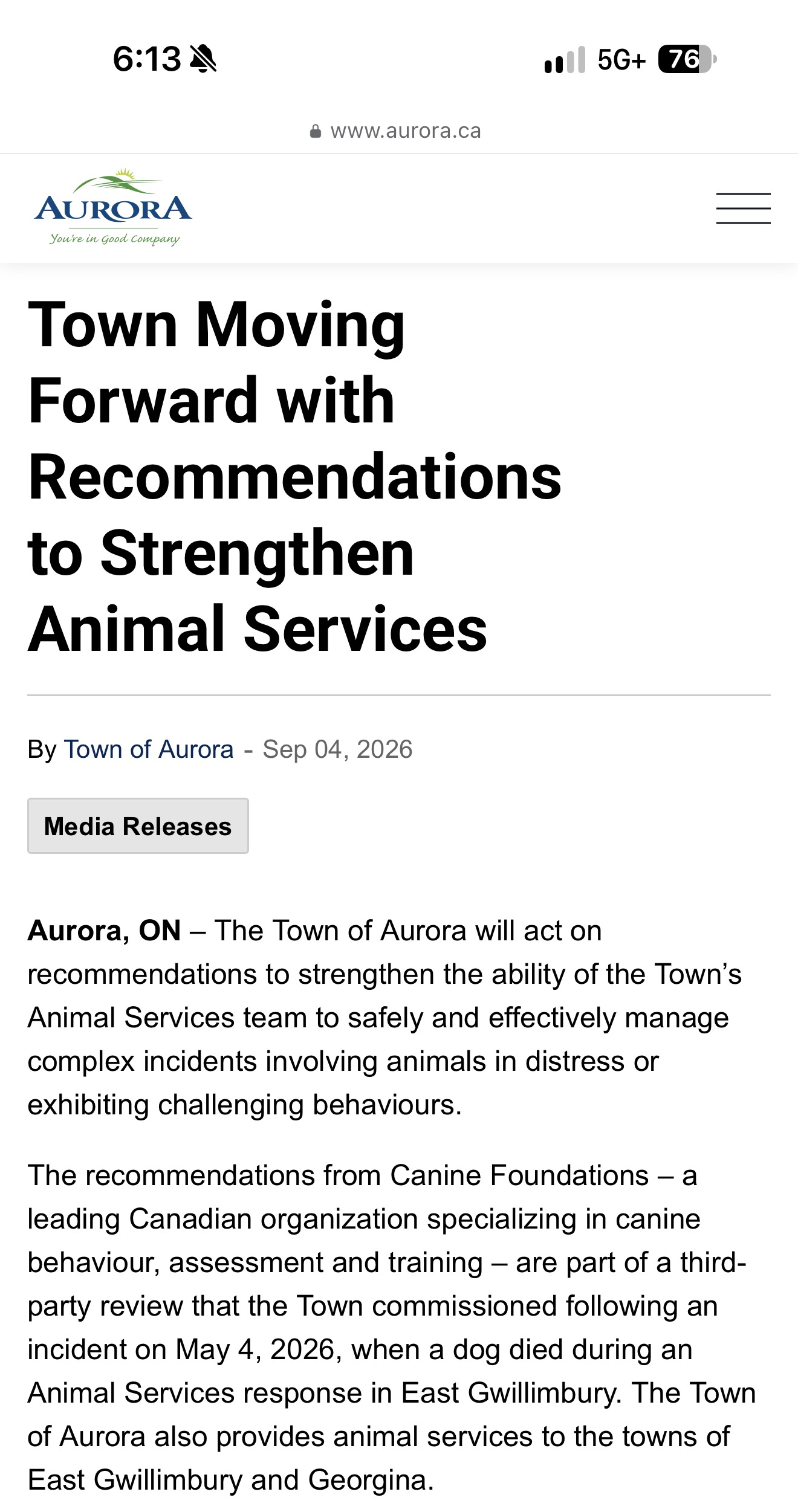
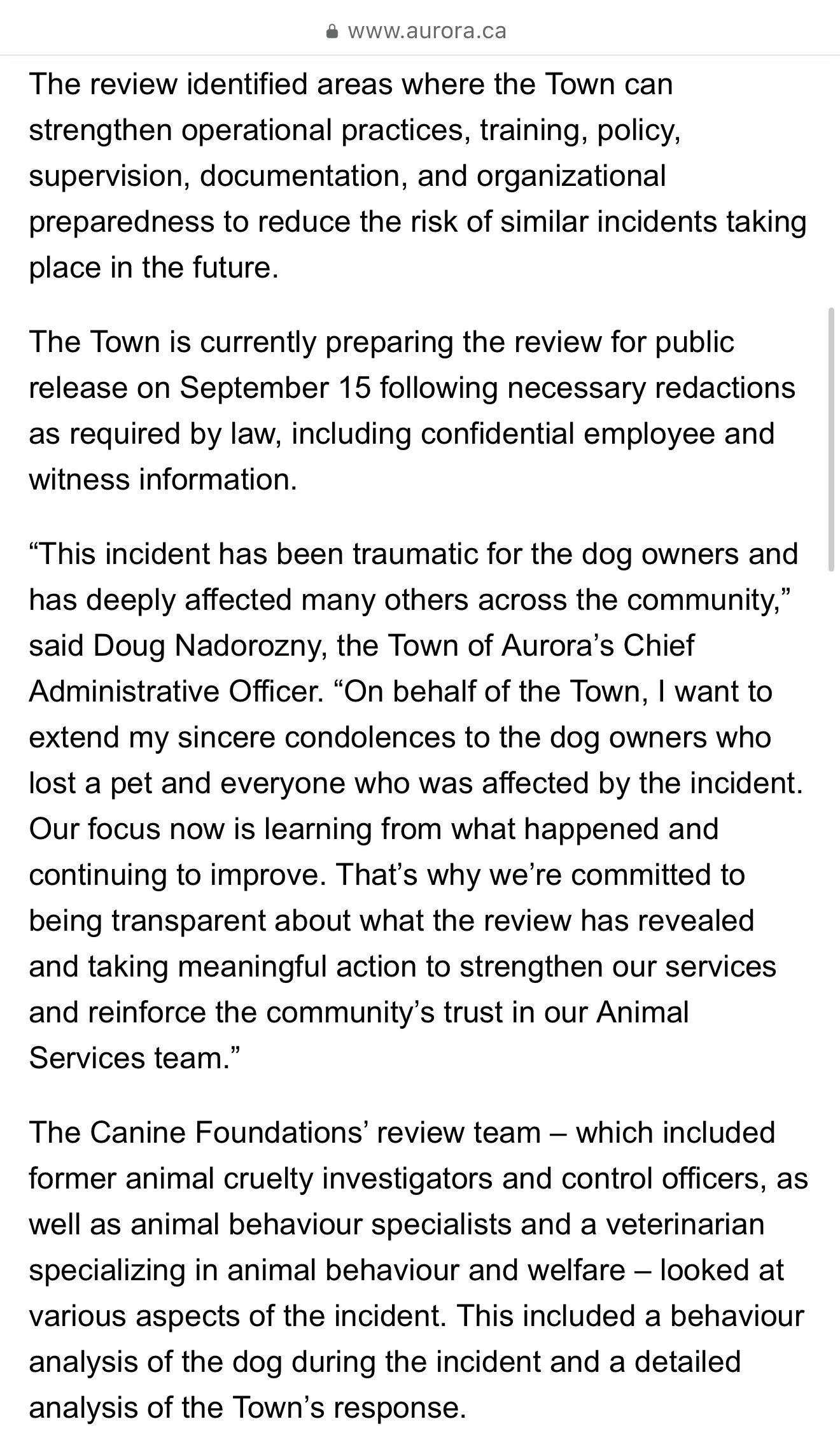
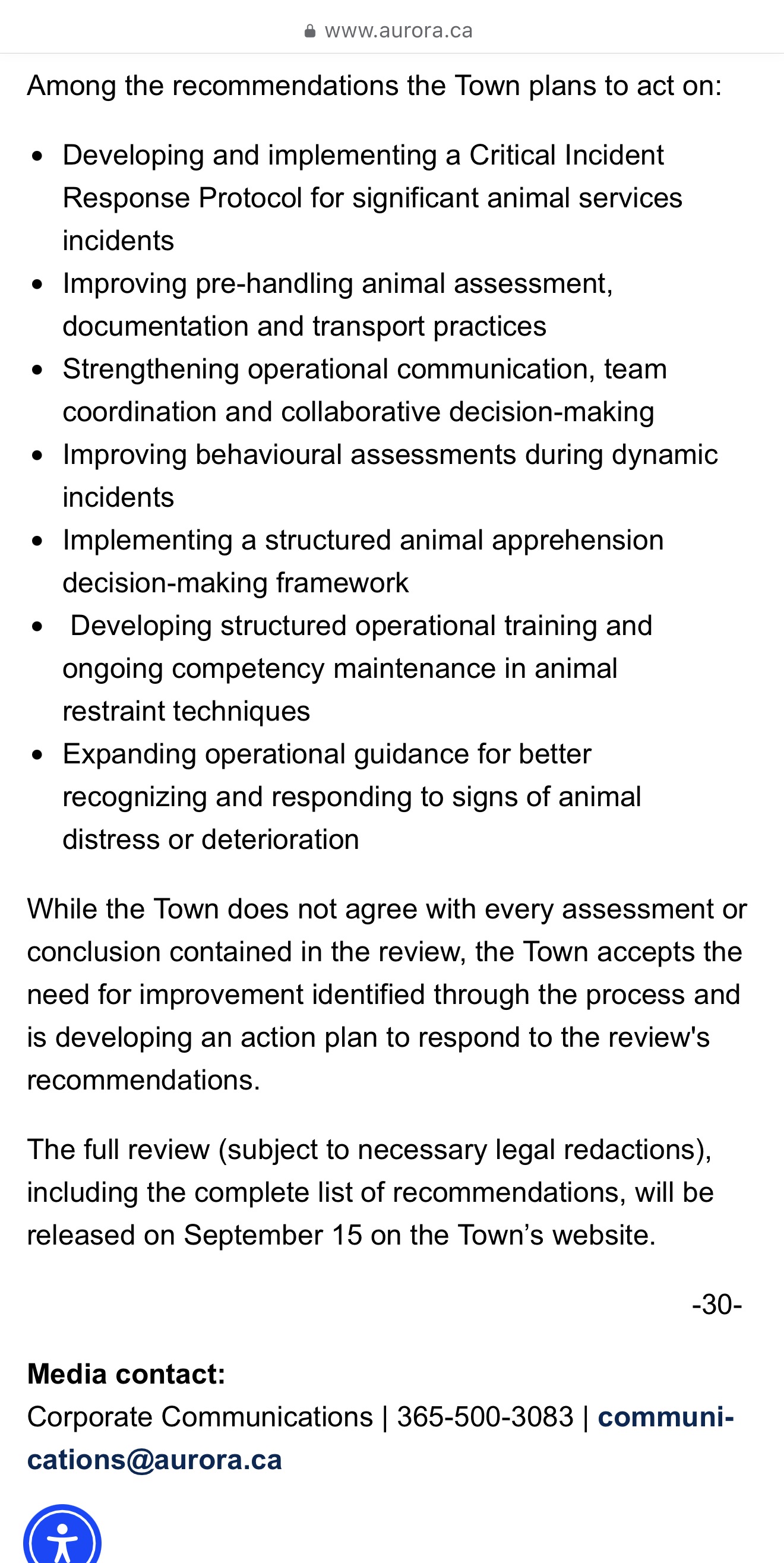
Source images: The Town of Aurora media release dated September 4, 2026. Read the full official media release
The Town of Aurora described the Canine Foundations work as a "third-party review." It said the review team examined:
"various aspects of the incident"
including a behavioural analysis of Heiniu and a detailed analysis of the Town's response.
The Town also stated:
"The Town does not agree with every assessment or conclusion contained in the review."
The Town did not identify which assessments or conclusions it rejected, who made that determination, or the evidentiary or professional basis for doing so.
September 4, 2026 - Mayor Tom Mrakas
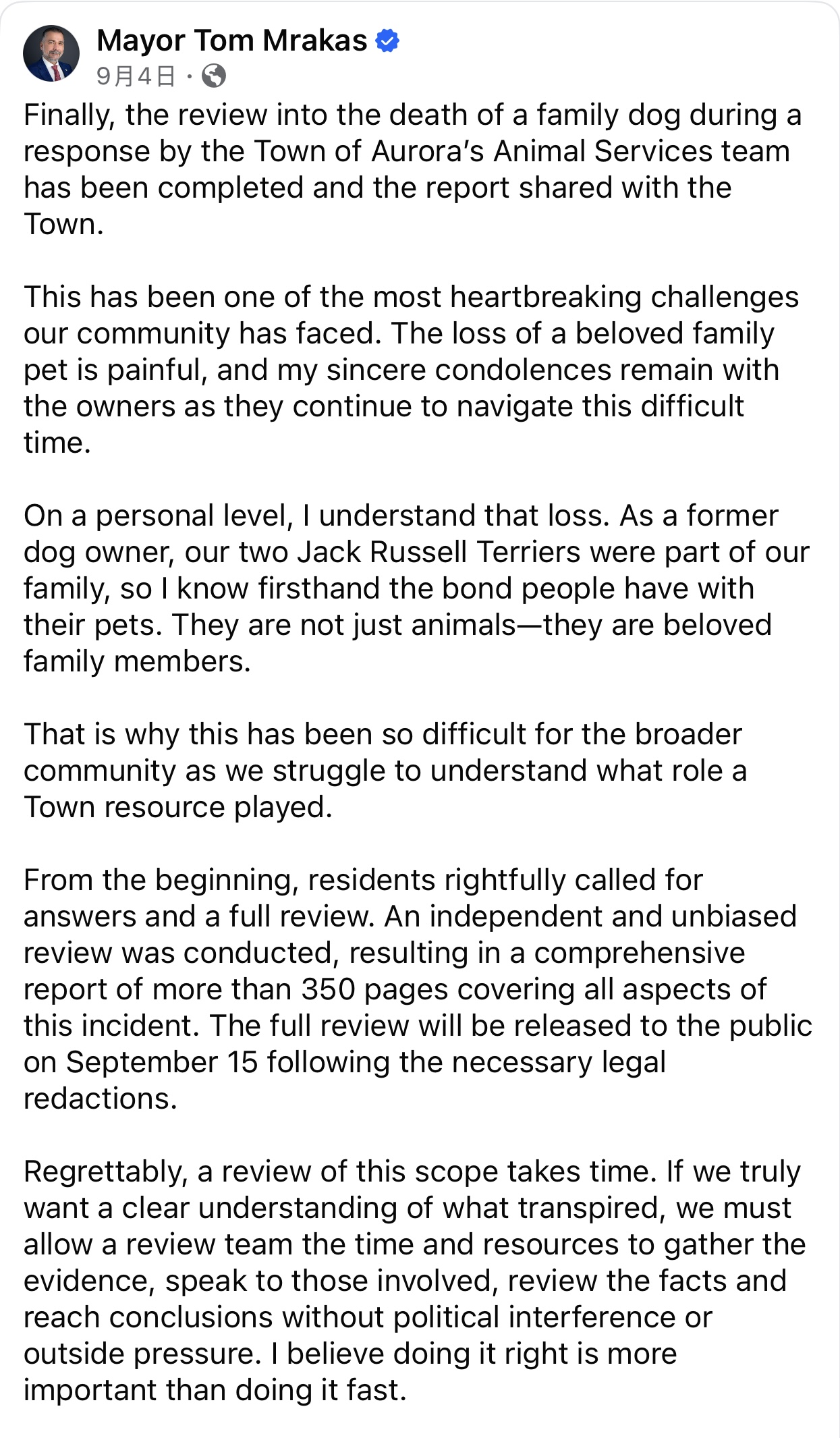
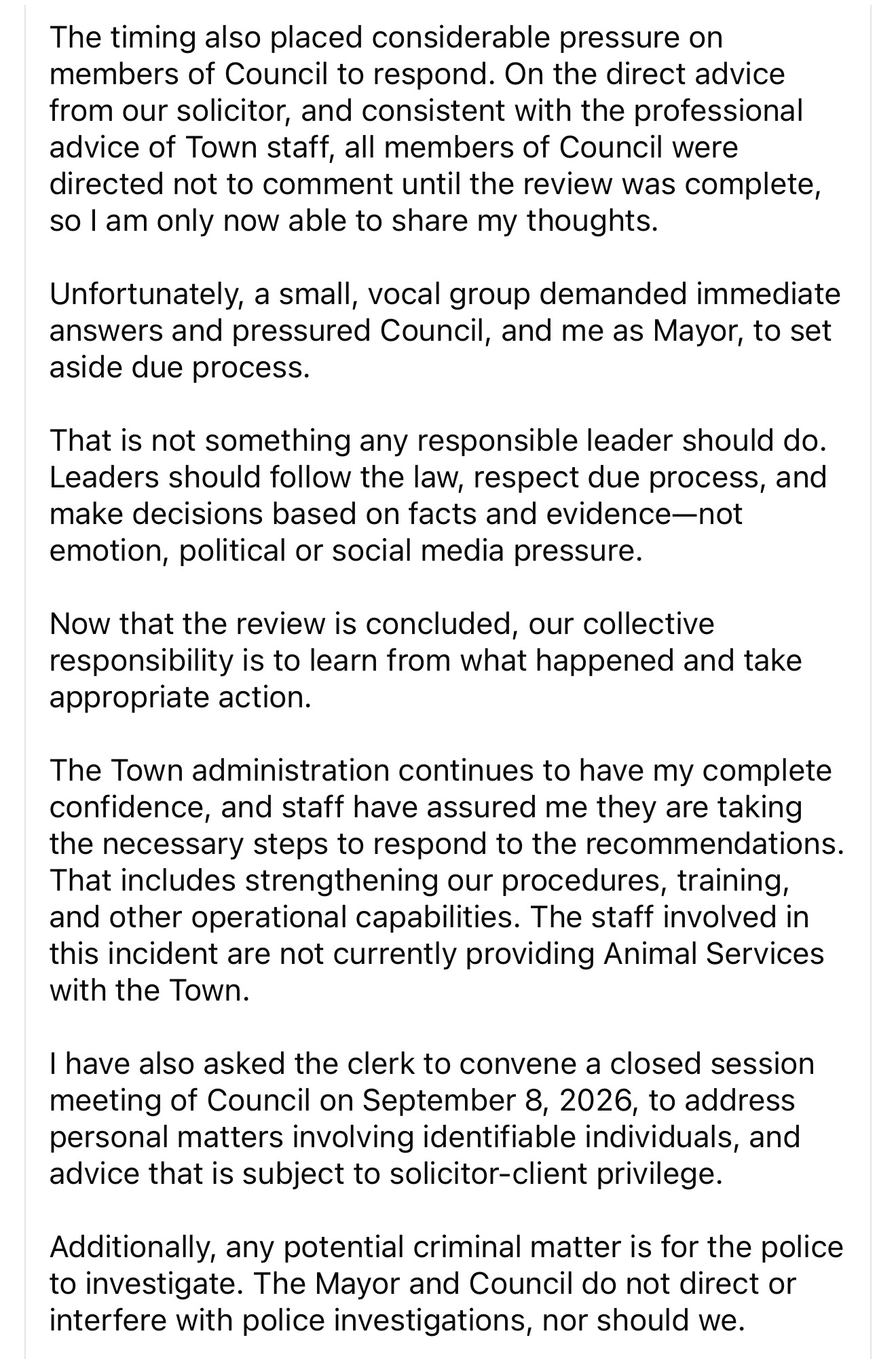
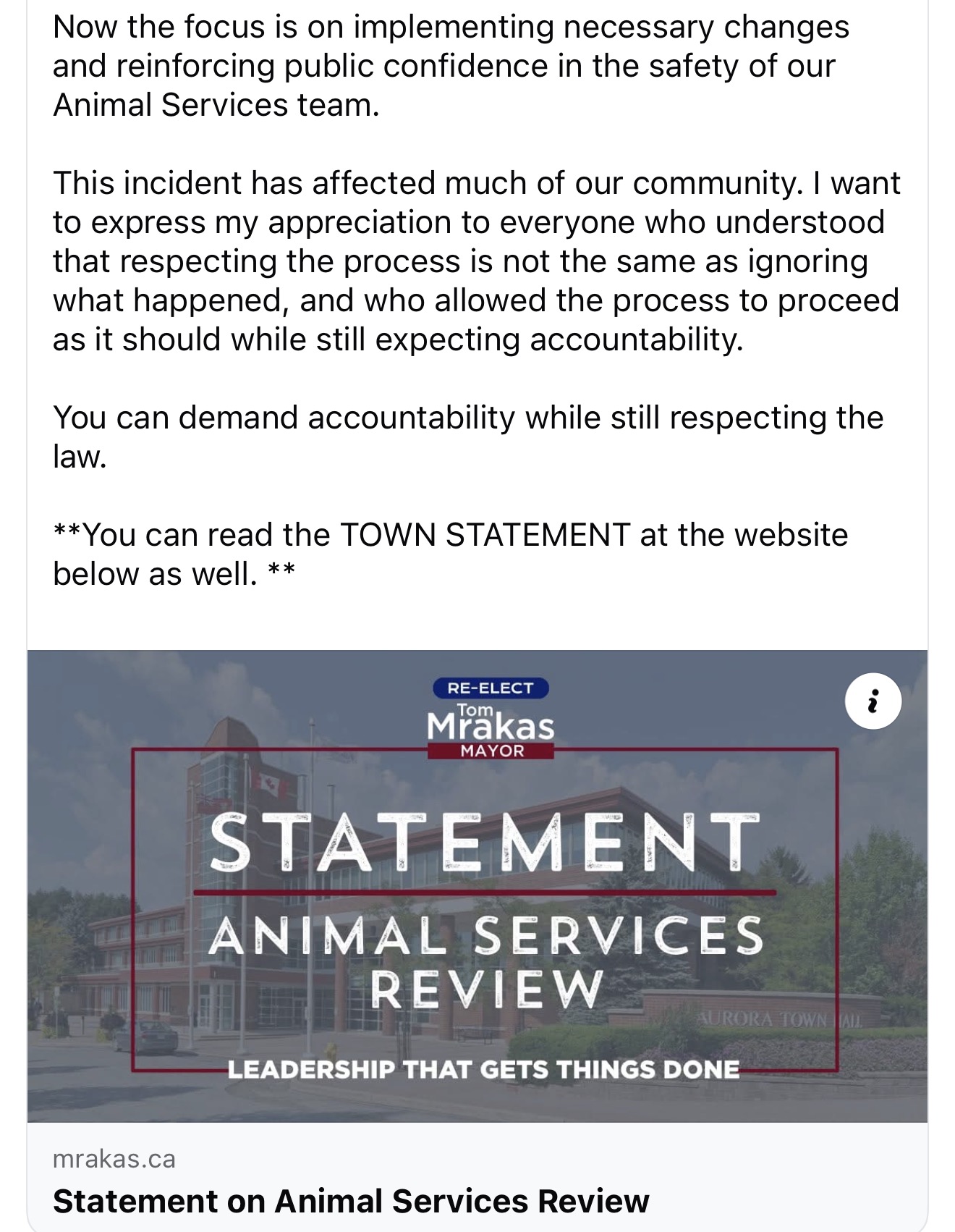
Source images: Mayor Tom Mrakas' statement dated September 4, 2026. Read the official statement on the Town of Aurora website
On the same day, Mayor Tom Mrakas used broader language. He called the work:
"an independent and unbiased review"
and described the resulting report as:
"covering all aspects of this incident."
He said that, on the direct advice of the Town's solicitor and consistent with the professional advice of Town staff, all members of Aurora Town Council had been:
"directed not to comment until the review was complete"
He described those seeking immediate answers as:
"a small, vocal group"
that had pressured Council and the Mayor:
"to set aside due process."
Mayor Tom Mrakas also stated that the Town administration continued to have his:
"complete confidence."
These were political and institutional statements. They were not contractual amendments and they did not expand the legal scope of the commissioned services.
September 15, 2026 - Public Release
When the Town of Aurora released the public report, it said that necessary legal redactions had been completed and stated:
"The substance of the report remains unredacted."
That statement created a standard against which the public release can be tested. It does not answer whether information was never collected, remained outside scope, was not provided to the reviewer, or was excluded from the public version under the Town's contractual discretion.
2. What the Contract Actually Says
The contract disclosed by the Town of Aurora through FOI2026-29 identifies the parties as Canine Foundations Behaviour & Obedience Training Inc. and The Corporation of the Town of Aurora. The project is identified as the Core Multidisciplinary Operational Review & Risk Reduction Assessment.
The contract must be read as a whole. Reading only its main body would be incomplete. Reading only Appendix A would also be incomplete.
Appendix A authorized broad operational methods
Appendix A was not narrow. It described a comprehensive operational review of the incident and authorized work that included:
- officer notes and statements;
- direct witness interviews and statement collection;
- video and photographic evidence;
- timeline reconstruction and incident sequencing;
- canine behavioural analysis;
- tactical and operational decision-point analysis;
- contributing-factor identification;
- review of training standards, equipment and handling tools;
- veterinary or medical information used to assist behavioural analysis; and
- behavioural and operational findings and risk-reduction recommendations.
Appendix A also expressly placed the following outside scope:
"Interview with the owners of the deceased animal"
and:
"Any services not expressly included in the Services listed above."
The body of the contract imposed controlling limits
Section 4(1) provides that, in the event of conflict or inconsistency between the body of the contract and an appendix, the body prevails.
Section 5(4) states:
"The parties agree that the Services are focused solely on reviewing and making recommendations regarding the Town's policies and procedures for animal handling. The Services are not a parallel investigation to, nor will provide any opinion regarding any other matters related to the recent animal death, such as animal welfare, or employment-related matters."
Section 5(7) further states that the services are not legal advice and are point-in-time advice based on information provided to the consultant.
The legally important distinction is therefore not that Appendix A prohibited all incident analysis. It did not. The distinction is between method and mandate.
The contract permitted investigative methods. It limited the purpose and legal significance of the work.
Canine Foundations could reconstruct the incident, interview witnesses and analyze behaviour in order to assess policies, procedures, training, operational decisions and future risk. That did not automatically turn the work into a parallel investigation capable of finally determining legal liability, employment responsibility, animal-welfare compliance or the cause of death.
3. Why "All Aspects" Requires an Explanation
The public record contains four materially different descriptions:
| Source | Exact description |
|---|---|
| Mayor Tom Mrakas, May 7 | "conducting an investigation" |
| Contract, Section 5(4) | "not a parallel investigation" |
| The Town of Aurora, September 4 | "various aspects of the incident" |
| Mayor Tom Mrakas, September 4 | "covering all aspects of this incident" |
These descriptions cannot be treated as interchangeable.
"Various aspects" and "all aspects" do not describe the same scope. An operational review using investigative methods is not the same process as an investigation authorized to determine every disputed fact or assign responsibility.
At least three explanations remain possible:
- a separate investigation existed in addition to the Canine Foundations review;
- the Canine Foundations mandate was formally expanded; or
- the Town regarded the broad methods in Appendix A as part of an operational review while maintaining the limits in Section 5(4).
Each explanation creates a documentary question. If there was a separate investigation, where are its mandate and outcome? If the mandate changed, where is the written change? If the Town relies on the third explanation, where did it draw the boundary between operational analysis and the animal-welfare, employment-related or other opinions excluded by Section 5(4)?
4. Independence Is a Structure, Not a Label
This article does not allege that Canine Foundations or any member of its review team acted with bias. It asks what Mayor Tom Mrakas meant when he publicly called the work "independent and unbiased," and what safeguards supported that description.
The contract gave the Town of Aurora significant roles in the process:
- the Town could monitor the project on an ongoing basis;
- the Town could provide feedback and direction;
- the Town reviewed deliverables and could identify deficiencies;
- the Town was responsible for the accuracy and completeness of the information it supplied;
- the consultant was entitled to rely on Town-supplied information and was not required to verify its accuracy or completeness;
- interviews with Heiniu's owners were outside scope;
- without the Town's prior written consent or direction, the consultant could not make a public statement or communicate with the media or a third party about the services, project or Town; and
- the Town could disclose reports and analyses, in whole or in part, at its discretion, subject to applicable law.
None of these provisions, standing alone, proves improper influence. Together, however, they make the structure of independence a legitimate public issue.
The appropriate questions are concrete:
- What information was selected and provided by the Town?
- What information was requested but not provided?
- What independent verification was performed?
- What prior professional or training relationships existed between Canine Foundations and the personnel whose actions were examined?
- What actual or potential conflicts were disclosed under the contract's conflict-of-interest provisions?
- What safeguards prevented the Town's monitoring, feedback, deliverable review and publication control from affecting the analysis or public presentation?
Those questions do not accuse anyone of misconduct. They test a public claim against the structure of the written agreement.
5. What the Delivered Report Actually Did
The delivered report was not confined to listing prospective policy recommendations. Among other things, it contained:
- a reconstructed incident timeline and analysis of discrepancies among accounts (report, pp. 23-45);
- a multi-phase behavioural and bite analysis of Heiniu (report, pp. 46-82);
- assessments of restraint, handling practices, operational decisions and physiological deterioration (report, pp. 83-113);
- findings concerning training, communication, documentation, supervision and operational decision-making (report, pp. 114-176);
- a finding that key safety elements of the officers' training were not applied during portions of the incident (Finding 16, report, pp. 171-172);
- a finding that restraint-related injury remained a potential contributing factor that could not be excluded, while causation could not be determined from the available evidence (Finding 19, report, pp. 174-175); and
- an appendix headed "Investigator Qualifications" (report, pp. 355-358).
Much of that work can be connected to the broad operational methods set out in Appendix A. The unresolved issue is how the report's incident-specific and employee-specific findings were kept within the controlling limits of Section 5(4).
That question is especially important where the report addressed training compliance, restraint-related injury and the physiological deterioration preceding Heiniu's death, while the contract stated that the services were not a parallel investigation and would not provide opinions on animal-welfare or employment-related matters.
The report may support operational reform. It cannot properly be treated as an exoneration or as a substitute for every other investigative, regulatory or legal process. Its own contract did not authorize that role.
6. The Town's Undisclosed Disagreements
The Town of Aurora publicly stated that it did not agree with every assessment or conclusion in the report. That statement should not remain abstract.
The public should be told:
- which assessments or conclusions the Town rejects;
- who made each decision to reject them;
- whether the decision was made by elected officials, senior administration, legal counsel or another expert;
- what evidence or professional opinion supported the rejection; and
- whether the rejected assessments affected the action plan or any employment, training, supervisory or operational decision.
Mayor Tom Mrakas's statement of "complete confidence" in the Town administration is a political judgment. It does not answer these documentary questions.
7. Advice, Direction and Council Silence
The public descriptions also changed from members of Council being "advised not to comment further" to Mayor Tom Mrakas saying that all members had been "directed not to comment."
Legal advice and a binding direction are not the same thing.
The public record should establish:
- who issued the direction;
- whether it was oral or written;
- what legal or administrative authority supported it;
- when it began and ended;
- whether it applied equally to the Mayor, councillors and staff; and
- whether it prevented elected representatives from asking questions without disclosing protected personal or legal information.
Calling public demands a request to "set aside due process" also requires particulars. Mayor Tom Mrakas did not identify which specific request required Council to break the law or abandon procedural fairness. Asking for the mandate, evidence, missing records and accountable decision-making is not the abandonment of due process. It is part of public accountability.
8. What the Public Record Establishes - and What It Does Not
The public record establishes that:
- Mayor Tom Mrakas announced an investigation on May 7;
- before that review was complete, the Town's May 12 statement publicly characterized the call, the bite, the reason for police assistance, staff conduct and Heiniu's loss of responsiveness;
- the later report established important context not included in that statement, including prior containment on private property, initial loading without reported difficulty, a context-dependent defensive bite assessment, departures from training and a potential restraint-related contributing factor that could not be excluded;
- the later contract expressly said the Canine Foundations services were not a parallel investigation;
- Appendix A authorized broad operational methods and incident analysis;
- the body of the contract limited the purpose of those services and prevails in the event of inconsistency;
- owner interviews were expressly outside scope;
- the contract contained written procedures for amendments and additional services;
- the contract gave the Town roles in information supply, monitoring, feedback, deliverable review, consultant communications and public disclosure;
- the Town described the review as examining "various aspects";
- Mayor Tom Mrakas described it as covering "all aspects" and as "independent and unbiased"; and
- the delivered report contained incident-specific, restraint-related and employee-specific assessments in addition to future recommendations.
The currently available public record does not establish:
- what verified evidence supported each material factual characterization in the May 7 and May 12 statements, who approved those statements, or whether a correction or clarification was considered after the report was delivered;
- what investigation Mayor Tom Mrakas announced on May 7;
- whether it was separate from the Canine Foundations review;
- whether the Canine Foundations mandate was formally amended;
- what safeguards supported the description "independent and unbiased";
- how prior professional or training relationships were assessed and disclosed;
- which report assessments or conclusions the Town rejects;
- who directed Council members not to comment and under what authority; or
- how the Town determined that the substance of the report remained unredacted.
9. The Records That Should Be Produced
The questions can be narrowed to seven categories of records:
- the records, source material, drafts and approvals supporting the May 7 and May 12 public statements, including any later consideration of correction, supplementation or clarification;
- the mandate, responsible decision-maker, work product and outcome of the investigation announced on May 7;
- any written amendment, change order, revised work plan, quotation or approval that altered the Canine Foundations mandate;
- records assessing independence, prior relationships and actual, potential or perceived conflicts of interest;
- the written legal or administrative basis for directing members of Aurora Town Council not to comment;
- records identifying the assessments or conclusions rejected by the Town and the basis for each rejection; and
- a redaction and withholding explanation sufficient to test the Town's statement that the substance of the report remained unredacted.
If the records exist, producing them will answer the questions. If they do not exist, that is also a material fact about the process.
10. Why This Matters Beyond One Report
Six principles extend beyond the death of Heiniu:
- A public body that relies on an incomplete review to withhold details should identify the evidentiary basis for the substantive details it chooses to publish.
- A public statement does not amend a contract.
- Investigative methods do not necessarily create an investigation authorized to determine responsibility.
- Independence must be demonstrated through structure, disclosure and safeguards, not only asserted as a label.
- Operational reform does not replace accountability for the incident that made reform necessary.
- Where the documents do not establish an answer, the responsible conclusion is that the question remains unanswered.
A 362-page report may contain valuable work. Page count does not enlarge a written mandate. Recommendations about the next incident do not, by themselves, explain this one. Confidence expressed by a political officeholder does not replace documentary answers.
The public descriptions, the contractual limits, the contractual control structure and the delivered report do not fit together without further explanation and further records.
For now, that is the conclusion supported by the public record.
Primary Sources
- FOI2026-29 - Canine Foundations contract body and family-prepared summary of Appendix A (records package, pp. 19-23)
- Mayor Tom Mrakas' Statement on Animal Services Incident in East Gwillimbury - May 7, 2026
- Mayor Tom Mrakas' Statement on Animal Services Review - September 4, 2026
- May 12, 2026 statement from the Town of Aurora
- September 4, 2026 media release from the Town of Aurora
- September 15, 2026 media release from the Town of Aurora
- Full Canine Foundations Final Review Report - August 21, 2026 (PDF)
Related Statement from Counsel - Separate Document
This article is Yang Yu's document review. It is separate from the formal statement prepared by Jennifer Friedman, Barrister and Solicitor, on behalf of Yang Yu and his family. Read counsel's statement in its original, unedited form:
Statement on Behalf of Yang Yu and His Family - September 17, 2026